History


Located next to the St-Lawrence river, in Saint-Jean, on Île d’Orléans, the Mauvide-Genest manor was built in 2 phases between 1734 and 1752. At first, Jean Mauvide built a solid square house on the lot he was given by his father in law Charles Genest. Later, as his business grew, he decided to make it bigger, turning it into a massive stone house that would reflect his activities and his Seigneur status. It most likely his father in law’s support combined with the island’s fertile soil that allowed Jean Mauvide to get started into shipbuilding and become a powerful businessman.
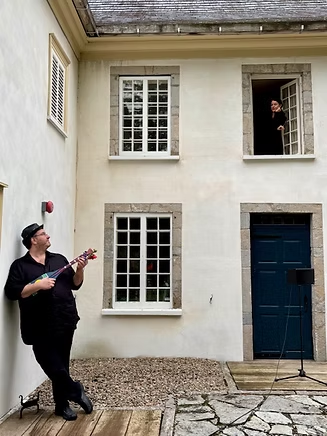
From an architectural standpoint, Manoir Mauvide-Genest is a tribute to all 18th century architectural currents with it’s square made of stone, roof slope and 7500 square feet over 4 floors. It’s a rare exemple of Seigneurial manors built countryside affixed during Louis XV’s period that has it’s initial structures still intact.
Interestingly, it’s through the couple’s 2 daughters that ownership of the manor was passed on, since they never had a son. The first daugther, Marie-Anne Mauvide, married René-Amable Durocher who will also become Seigneur. Later, the second daughter, Marie-Anne Genest, married François-Marc Turcotte. It’s one of the latter family’s heir that sold the manor to judge J. Camille Pouliot in 1926. Judge Pouliot’s grand mother was named Marie-Angélique Genest, which explains why he chose to name the manor Mauvide-Genest.
At that point, the manor was in bad shape. The judge, who used it as a summer house, then decided to renovate it with the help of architect Lorenzo Auger. In short, the judge litterally saved the manor from falling to pieces. He also added a kitchen as an annex and a small chaptel for his sons that were priests.
A quote from one of judge Pouliot’s books, also a part-time writer, allows us to get an idea of his state of mind when he bought the manor:
«When you come in this house, when you touch it’s thick walls decorated with bull-noses, when you go from the basement to the attic, through the rooms filled with history; you experience a strong yet pleasant emotion: admiration mixed with thankfulness towards our ancesters.»
Unfortunately, as the years passed, the decay of important wooden parts due to decades of rain, snow and infiltration made appropriate renovations of the manor too costly for an individual. This is why Antoine Pouliot, grandson of the judge, sold the manor to a non-profit organisation: Société de développement de la Seigneurie Mauvide-Genest
In 1999, the Société started a new round of efforts to salvage the manor. The directors’ implication resulted into a partnership with the federal and provincial governement to fully renovate the manor. All of this was also made possible because of the fact that the manor has been declared cultural property since 1971 by Quebec’s governement and recognized for it’s outstanding historical and architectural value since 1993 by the commission on historical monuments and properties of Canada.
In 2001 the manor, looking just like it used to, opened it’s door to the public again. The authorities took the opportunity to establish a clear vocation for the manor: interpretation of it’s period and of it’s historical role. Manoir Mauvide-Genest, a real museum because of it’s age, then became an interpretation center, one of a kind in North America, who’s mission is to educate people on the Seigneurial system which was in place in Canada before the 1763 conquest.
The story of the manor goes on and is maintained by the questions of it’s visitors. Please take part of the Manoir’s legacy by visiting!
When the surgeon becomes a Seigneur


Jean Mauvide, a young french surgeon born in Tour in 1701 settles in Île d’Orléans upon his arrival in Nouvelle-France in 1721. He will fall in love with Marie-Anne Genest and will marry her in 1733. The couple will experience tremendous success together. Doctor, businessman and roadbuilder he also takes over management of the 4 mills of the island. In 1752, he purchases the western half of the island and becomes Seigneur. It’s at that time that he decides to transform the family’s home into the beautiful manor we all know today.